A manual
For those who play
A small book of explanations, kept beside the desk of every Child of Rome.
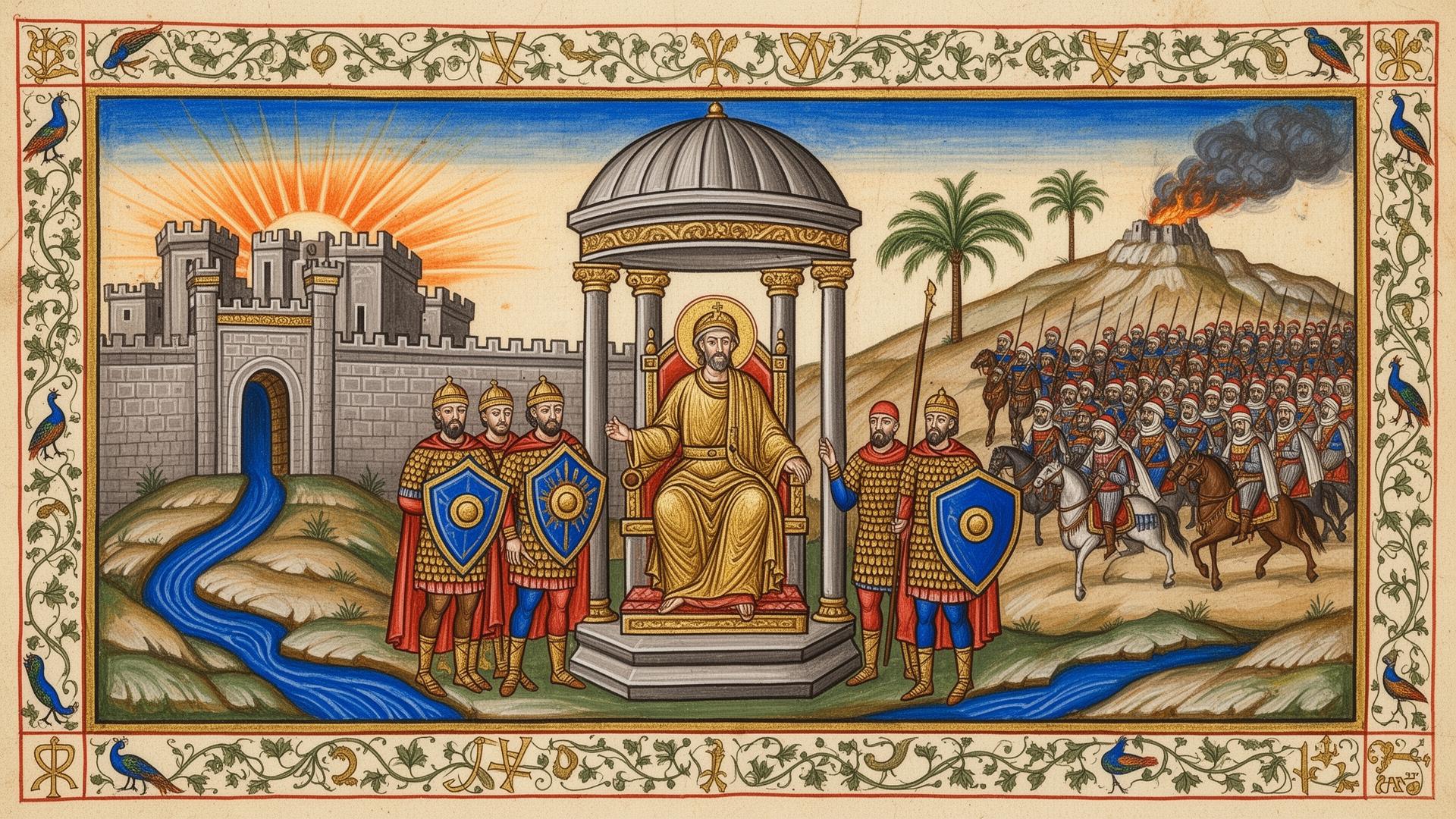
What a turn is
A turn is a single passage of time in the world — a week, a month, a year, as the season requires. You send the gamemaster your orders: what your character does, where they go, what they say and to whom, what they hope for. The gamemaster runs the world against your intentions and returns to you a dispatch: a sealed account of what came of it.
Even the simplest set of orders, filed honestly, earns a small grant of kleos. The empire notices those who write.
A sample packet of orders
There is no command grammar to learn and no form to fill. You write the chronicler a letter — in the first or second person, in your own voice or your character's — and the world replies. The packet below is a fair sample of the shape an experienced player tends to settle into: an opening declaration of intent, two or three concrete acts with named people and places, an honest question, and (when one is owed) a favour-token spent in plain words.
A Syrian Merchant's orders for the week of Pentecost
This week I mean to keep my head down and turn the Dorylaion wheat into coin before the requisition order is enforced on the Nicaean side of the lake. The grain is in the warehouse of Petros the Armenian, by the eastern gate. I will sell two thirds of it to the imperial commissary at whatever price they offer — better a thin profit recorded in the chartulary's book than a fat one that draws the strategos's eye — and hold the last third for the Bithynian millers, who I am told will pay in silver rather than receipts.
On Wednesday I will call upon the metropolitan's secretary, Demetrios, with a small gift of pepper and a request: that the monastery on Olympos be reminded of the seventeen nomismata they owe my late father's estate. I do not press; I only remind. If Demetrios names a price for the reminder, I will pay it up to three nomismata in coin or in kind.
I will also ask quietly, at the wharf, whether the courier who shared my fire on the eastern road has been seen returning. His name was Niketas. I owe him a cup of wine and perhaps a question.
A question for the chronicler: is the imperial commissary in Nicaea this week the same man I bribed at Sardis in the autumn, or has he been rotated? I do not wish to greet him too warmly.
I spend a favour of the Muses on the meeting with Demetrios. Let it go well.
Orders this length take fifteen minutes to write and earn the chronicler's full attention. Shorter is permitted — a single paragraph of plain intent will be run. Longer is welcome but not required.
The world you walk in
The chronicle opens in the year of the world 6346, by the Roman reckoning — what the Latins call 838, though no Latin has held the city for four hundred years. The empire stands on two legs: Constantinople, the New Rome, where the Basileus Theophilus holds court; and the themes, the military provinces that feed and defend it.
You begin in Nicaea, on the Asiatic shore of the Propontis. It is a garrison city, a crossroads, a place where the road from the capital meets the road to the eastern frontier. The walls are sound. The lake is full of fish. The strategos of Opsikion is in residence, the metropolitan is in conference, and imperial couriers ride through the gate at all hours. The price of horses has tripled in a fortnight.
The reign of Theophilus
Theophilus is the second emperor of the Amorian house — soldier, builder, iconoclast. He has spent the spring campaigning in the Caliph's lands; he took Sozopetra and gave it to fire. It is said that the Caliph al-Muʿtasim received the news in his bath at Samarra and rose dripping and unspeaking, and that he has since sworn before his father's tomb to take a Roman city of equal dignity. He has named it: Amorium, mother of the Amorian house. From Khorasan and the eastern marches he summons an army not seen in the lifetime of any man under sixty.
The empire you serve
The Roman Empire of this age is not the ancient marble thing. It is a lean, pious, quarrelsome state held together by the army, the tax-roll, and the Orthodox faith — though even the faith is contested. Theophilus is an iconoclast: he believes the sacred images are idols, and his soldiers have whitewashed churches from Ephesos to the Halys. The monks weep. The iconophiles plot. The patriarch is careful.
The empire is divided into themes — military provinces commanded by a strategos, who holds both the sword and the tax-register. The great themes of the East are Anatolikon, Armeniakon, Opsikion, Thrakesion, and the maritime themes of the Aegean and the Kibyrrhaiotai. Each theme musters its own soldiers, feeds them from its own estates, and answers the emperor's call when the golden seal is sent. In time of peace the themes feud among themselves. In time of war they remember that they are Romans.
The city and the margin
Most players begin in Nicaea, but the empire is wide. Constantinople is the centre — the Great Church, the Hippodrome, the Bronze Gate, the palace complex where eunuchs and logothetes move in corridors that no map records. Beyond the themes lie the margins: the Arab frontier along the Taurus, the Bulgarian kingdom to the north, the Khazar steppe, the Italian possessions clinging to the toe of the old boot. The sea is full of pirates who were once imperial marines. The mountains are full of hermits who were once courtiers.
You need not be a soldier or a saint. The chronicle has room for merchants, physicians, architects, smugglers, and the merely curious. What matters is that you write.
The dispatch you receive
Each dispatch is dated by the in-world calendar and by the day it was sealed. It contains:
- The narrative — what happened, told in the third person, in the manner of a private letter from a careful clerk.
- The ledger — income and expense for the period, opening and closing balances.
- The fiscal mood — whether your house feels comfortable, stretched, dangerous, or ruinous.
- Rumours and gossip that reached you.
- A short word on your successor.
- The asks — what the gamemaster needs an answer to before the next turn.
- Sometimes, a further scene — a vignette with no mechanical weight, only colour.
What it sounds like
The following are not real dispatches from any living player; they are samples of the voice the chronicler uses — the prose you will find in your scroll when a turn is run.
From a Syrian Merchant, Spring 838
You rode east from Nicaea at the end of March, before the cherry trees had come fully into flower, with a string of six mules and a contract in your sleeve for five hundred modii of wheat from the threshing-floors outside Dorylaion. The road was crowded with soldiers moving the other way — Thrakesian thematic troops, unkempt, loud, and already selling their rations for wine. You gave them a wide berth. At the second posting-station a courier in imperial livery overtook you, and you shared his fire. He told you that the Caliph's vanguard had been sighted on the Halys, and that the strategos of Anatolikon had issued a requisition order for every horse and donkey on the road. You spent the next three days forging a letter of exemption on the stationery of a monastery you had never visited. It passed. The wheat is yours. It is already worth three times what you paid.
From a Lady of the Basilike, Spring 838
You attended the liturgy at the metropolitan church on the Sunday before the Annunciation, seated in the forward benches with the wives of the strategos and the provincial judge. The bishop preached on the parable of the ten virgins — at unusual length, and with several glances in your direction. Afterwards, in the narthex, the abbess of the convent on Olympos approached you with an unsigned petition: three nuns are to be expelled for iconophile sympathies, and the abbess does not wish to sign her own name to the accusation. You took the paper. It is warm in your hand. You have not yet decided what to do with it.
From a Tagmatic Officer, Spring 838
The muster was called at dawn on the fifteenth of the month. You brought forty-seven men from your father's estate — well mounted, poorly armed, three with real mail, the rest in leather and hope. The strategos inspected them personally. He said nothing, but his secretary wrote a note. You were billeted in a warehouse near the lake, given barley bread and mackerel, and told to wait for the imperial tagmata from Constantinople. On the fourth day of waiting a fight broke out between your men and a Thrakesian band over a dice debt. No one died, but a nose was broken and blood fell on the warehouse floor. You paid the surgeon two nomismata from the purse. The men look at you differently now. Some with respect. Some with calculation.
The purse, the ledger, the holdings
The purse is what you carry — coin in hand, in nomismata. The holdings are what you own: estates, an inn, a share in a wharf, the quiet things in cellars. Each turn the ledger sums their incomes, subtracts your expenses, and updates the purse. You see the figures. So does the gamemaster. Secret holdings are listed in a private section visible only to you.
Debts, and the men who hold them
A debt is whatever you and the lender agreed to. There is no fixed rate of usury in this game; there are terms. A monastery may want patient instalments and a saint's day mass. A patrikios near the Basileus may want a vote, a silence, a son's career. A loan-shark may want a finger, or worse. The terms are written into the debt; the gamemaster will hold you to them.
Favour of the Muses
On occasion your dispatch will note that a small favour of the Muses lingers with you, to be spent at need. This is a favour-token: a small reservoir of fortune you have earned and may spend.
How they are earned
The gamemaster grants them when a set of orders shows real care — when you write in character; when you invent rumours, songs, overheard speech, sermons; when you engage with the season's motifs; when you pick up threads from earlier turns; when you make a costly or vivid choice instead of the safe one.
How they are spent
To spend a token, name it plainly in your next orders: "I spend a favour of the Muses on the meeting with the eparch." The scribe will hear the words — phrases like spend a favour, burn a favour, or call on the Muses are all caught — and one token is debited from your reservoir automatically. The chronicler is then bound to narrate that scene more generously to you: a stranger remembers a kindness, a soldier looks the other way, a letter arrives at the right hour, the dice turn. A token is not a guarantee of success, but it is a thumb on the scale, in your favour.
What a favour will not do
A favour of the Muses is fortune, not absolution. It cannot erase a standing debt, nor wave away a mechanical penalty the chronicler has already named — a wound, a confiscation, a sentence of exile, the terms of a loan. The Muses bend the world a little; they do not unwrite what is already written.
If you would have a favour touch such a thing, you must offer a costly compromise in character: a public confession, a ruinous gift to the wronged house, a vow taken before the altar, a year of service. The chronicler is the final arbiter of whether the offered price is enough, and what the Muses then permit.
Kleos — the chronicler's measure
Kleos is the Greek word the chronicler keeps for fame: not coin, not station, but what the city will openly admit to remembering of you. When a turn produces a public deed worth noting, he writes it down with a number beside it. Good public deeds carry positive points; ruinous public ones carry negative — a coward seen fleeing is still seen.
Kleos is what the Logothete's office, the Patriarch, your peers at court, and the parish priest will say of you to your face. It is the ledger of the spoken reputation. What is whispered behind the hand is another book entirely — see Infamy.
How kleos is earned
- Orders filed at all — even a brief, plain set of orders earns a small reward. The empire notices those who keep writing. (Signed +2, anonymous packets +1, capped at +4 in any seven-day stretch — the chronicler will not be flattered by mere persistence.)
- Orders written with care — voice held in period, rumours invented, motifs taken up, threads picked up, the costly choice made. (+3 to +10, depending.)
- Deeds the world notices — a stand at the wall, a generous feast, a fast kept publicly, a stratagem that turned a market or a battle. (+5 to +25.)
- Citation by an NPC — a sermon names you, a song carries your house, a patrikios writes you into a dispatch of his own. (+5 to +15.)
How kleos is lost
Negative awards mirror positive ones. The chronicler will warn you in the dispatch before a loss drags you below a threshold you had previously cleared.
- Cowardice publicly witnessed — a flight from the wall, a duel refused before the company, an order disobeyed in sight of the men. (−5 to −15.)
- An oath broken in writing — a contract repudiated, a letter of guarantee disowned, a vow taken before the altar set aside. (−10 to −20.)
- An ally betrayed and the betrayal known — a kinsman denounced, a patron's confidence sold, a friend's signature forged. (−15 to −30.)
- Public scandal at court — a brawl at a feast you hosted, a charge of heresy that stuck, a denunciation in the Hippodrome. (−20 to −40.)
- Burning kleos — kleos is occasionally spent rather than lost: called in for a re-roll of a doomed scene, for a mercy, for a rumour stilled at the right ear. (−1 to −5, by your own choice.)
What kleos is spent on
Kleos is not a purse you empty. It is a standing the city accords you. What kleos unlocks is the right to petition — for a vocation, an advanced class, a second path, or (for the classless) to be taken in as one of the named callings. The number persists; the petition either succeeds, or is set aside for now.
The four axes of renown
Kleos is the sum; renown tells the shape of it. Every significant deed may also be tagged with one of four axes:
- Piety
- The fast kept, the alms given without trumpet, the pilgrimage made, the silent hour.
- Cunning
- Stratagem, the well-laid trap, the rumour planted at the wharf, the contract drawn so the other man signs his own confusion.
- Largesse
- The open hand: the public feast, the dowered orphan, the bridge repaired at private cost, ruinous generosity that buys love and credit.
- Valour
- Steel met without flinching. The wall held, the charge ridden, the duel accepted when refusal was possible.
You need not pursue all four; most Romans worth remembering are known for one or two. The axes accrue silently as the chronicler tags your deeds.
On the great philanthropies and household posts — the Orphanotropheion, the Vestiary, the Pharos, the chartularies — see Named offices, and how they are conferred.
Infamy — the shadow ledger
To be Roman is to wear two faces. Kleos is the face you present to the Logothete, to the Patriarch, to the parish at the Sunday liturgy. Infamy is the other face — what the bath-house knows, what the Varangians say over their cups, what your enemies' spies write in their ciphered dispatches. It is no small thing in this empire to be feared in the dark and bowed to in the light. The Phokades and the Skleroi built fortunes on exactly that doubleness.
Infamy is a parallel ledger, not a replacement for kleos. A character may hold high standing on both — that gap between the bright name and the dark one is one of the most Byzantine things you can cultivate. The chronicler tags deeds for infamy the same way he tags them for renown, on the same four axes:
- Piety
- The fanatic's cruelty, the heretic-hunter's pyre, the false relic peddled to a credulous monastery, the saint-act that no one is meant to admire openly.
- Cunning
- Blackmail, the forged seal, the bought witness, the bribe pressed into the right eunuch's palm. The clever villainy whispered about in the silentiarii's corridors.
- Largesse
- The protection racket framed as patronage, the dowry pressed on the girl whose silence you require, gold that buys loyalty and dependence rather than love.
- Valour
- The duel done quietly behind the cistern, the punitive raid passed off as a frontier patrol, the violence by which men learn not to speak your name above a whisper.
What infamy is for
For now, infamy is a parallel reputation track that the chronicler keeps for your character's villainous side. A single deed may carry both a public renown tag and a private infamy tag — the magnate who endows a hospital with one hand while running smugglers with the other earns Largesse renown and Largesse infamy from the same season's work.
The shadow ledger is no longer ornamental. It has its own ladder of advancement (below), its own moment of public consequence when it is dragged into the light (exposure), and its own politics of arm's-length sponsorship (patronage of villains).
Note for the GM: infamy is granted through the same Kleos award form as renown. Leave the public axis blank when the act is genuinely secret; set both when it has a public face and a private rumour.
The shadow ladder
The bright road is petitioned with lifetime kleos and a single tall axis of renown. The shadow road is petitioned with the sum of your four infamy axes — the chronicler tallies the whispers and weighs them. Four rungs are recognised:
- Claim a name in the dark — infamy sum 25, any axis ≥ 8. Petition to have your shadow reputation recognised by the chronicler as a standing thing: the bandits salute you, the watch knows the name. Not yet a calling — only a flag the world now flies for you.
Example: a Tax-farmer of Cunning-infamy 9 petitions to be known on the docks of Theodosia as the Magpie. Granted: thereafter, smugglers send him a percentage and call it a "blessing of the post." - Take a shadow vocation — infamy sum 50, any axis ≥ 12. A calling kept in the dark: a protection racket, a smuggling ring, a heresiarch's circle of pupils. It counts toward your vocation slots like any other.
Example: an Eparch's Informer of Cunning-infamy 13 petitions for the vocation Master of a Network of Eyes. Granted, with the burden that two of his informers will betray him within the year. - Petition for a shadow class — infamy sum 75, any axis ≥ 18. The mirror of an advanced class, conferred on the shadow road. Seven exist in the chronicle's keeping: Archpirate of the Aegean, Heresiarch, Master of the Underworld, Domestic Poisoner of the Sacred Palace, Captain of the Hidden Bandon, Bandit-King of the Taurus, and Master of the Counterfeit. The fiction must support it; the chronicler may refuse on grounds of plausibility alone.
Counter-example: a Renegade Deacon of Piety-infamy 14 petitions for Heresiarch. The chronicler returns not yet: pupils are wanting, and an axis of eighteen is not yet within reach. - Be reckoned a power — infamy sum 150, and two distinct axes at ≥ 15. The empire knows you must be reckoned with — by bounty, or by banner. From this rung onward, the Logothete's office contemplates either the standing army or the negotiated peace.
The lock between vocation and advanced class still binds. An ordinary character may take one second vocation or one advanced class in a life — and either may be a shadow one. The classless are exempt, and may take a shadow vocation alongside their bright ones, or a shadow class on top of a bright one. The road of the classless is wider, and rougher.
A note on the arithmetic
The attribute ceiling of twenty-two binds the inscription sheet — strength, dexterity, education, and so on. It does not bind renown or infamy axes; those are not attributes but accruing tallies kept by the chronicler as he tags deeds. An axis of eighteen, twenty, or thirty is permissible — and necessary, at the higher rungs.
For pacing: a focused villain who earns one tagged shadow deed a week at +2 to +3 reaches axis eighteen in roughly eight to twelve turns of consistent play, and the sum of seventy-five usually follows in the same season — the adjacent axes drift up alongside the favoured one, because few villainies wear only one face. Rung Three is meant to be a season of work, not a thing chosen at inscription. Rung Four (sum 150 and two distinct axes at fifteen) is the work of a long life, or a notorious one.
Exposure — when the dagger surfaces
Infamy is silent only so long as the wrong people do not know. When the rumour is proved, when the confession is public, when the man is caught in the act — the shadow ledger surfaces, and the bright one takes a wound. The chronicler marks the moment as an exposure: a kleos award (almost always negative) tagged with the shadow axis from which the rot came.
There are three classical shapes for it:
- The rumour proven. A whisper that has run for seasons finds its document — a customs ledger, a smuggled letter, a witness no one had thought to silence. The Logothete now knows, and the court must be told something. The shadow points do not vanish; they are doubled by their twin in the public ledger, and the public ledger is in the negative.
- The public confession. A man kneels at the ambo, or before the strategos, or in the Hippodrome itself, and names what he did. Confession purchases mercy on the day of judgment; it does not purchase silence on the day of telling. The chronicler may, by grace, allow some shadow points to be retired in exchange for the cost — a kind of penitential alchemy.
- Caught in the act. The patrol turns the corner; the bishop opens the wrong cellar; the kommerkiarios's clerk counts the bales twice. There is no rumour to deny and no confession to bargain over. The chronicler levies the heaviest version of the loss, and may add a wrath event or a debt as the world responds.
Mechanically, the GM uses the Exposure selector on the kleos award form to tag which shadow axis is being surfaced. The shadow score on that axis is preserved (the underworld does not forget what it knew), but the public ledger takes the loss — and the chronicler may, in the same turn, schedule a wrath event keyed to the exposed axis.
Patronage of villains
The most Byzantine arrangement in this game is the oldest one in the empire: a man of high kleos and a name to keep clean sponsors, at arm's length, a man of low kleos who does the work that cannot be done in the light. The Phokades did it. The Skleroi did it. The Logothete pretended not to notice, because he was doing it too.
In the chronicle, a patronage is a quiet binding the GM records: a patron, a client, and a single shadow axis on which the patron has an interest. So long as the binding holds, when the client earns infamy on the named axis, the patron is silently credited with a smaller share of the same — a single point per award, regardless of size. The patron's bright ledger is not touched. Only the shadow ledger thickens.
The cost is what the cost always is: the patron now has an axis of infamy that an enemy may someday expose. The bargain is favourable so long as the client is loyal and the chronicler is not paying attention; it is ruinous in the season the client is taken, turns king's evidence, or simply prays aloud to the wrong saint.
The GM binds and unbinds patronages from the Kleos & awards page. Players are not told the patron's name when the credit posts — only that the underworld has, for reasons of its own, decided to file the act under more than one ledger.
Advancement: the three roads
There are no levels and no hidden experience score. Advancement comes by petition: when your kleos and renown suit, you may write to the chronicler asking for what you have earned. He answers granted, denied, or not yet, and tells you why.
There are three ordinary tiers (and a fourth available only to the classless — see below):
- Vocation — at 25 lifetime kleos. A master in your trade takes you on; you bind yourself to a calling. Most characters take two; the classless may take three.
Example: a Lady of the Basilike at 30 kleos petitions to become Patron of a Lesser Monastery. Granted — she endows a small house on Olympos, and its abbot's secrets become, in some measure, hers. - Advanced class — at 75 lifetime kleos, with at least one renown axis at 5 or more. You take a deeper, named title within your path. Conferred only by the chronicler; the fiction must support it.
Example: a Tagmatic Officer of 80 kleos and Valour 6, who held the gate at Amorium, petitions to be raised to Strategos of his thema. Granted, with the burdens that follow.
Counter-example: a courtier of 90 kleos but no axis above 3 — spread thin, none ascendant — petitions to be raised to Logothete. The chronicler returns not yet: choose a road and walk it. - Multiclass — at 150 lifetime kleos, with one axis at 8 or more. You take a second class; the empire knows you on two roads.
Example: a Hesychast Monk of 160 kleos and Piety 9, who has also led a levy in the Bulgarian campaign, petitions to take up the path of Tagmatic Officer alongside his cassock. Granted: he becomes chaplain-captain of a tagma.
To lodge a petition, open the Soul tab of your scroll, where the progression panel shows your standing and the next threshold. When you are eligible, the petition form appears: name what you seek and justify it in your own voice. The chronicler will answer.
A denied petition is not a punishment. Not yet is the chronicler's most common reply, and it usually carries a note — which axis to lean into, which deed would tip the scale.
The vocation / advanced-class lock
In a single life, an ordinary character takes either a second vocation or an advanced class — not both. The choice between breadth (a second trade, a second income, a second hook) and depth (a named title, a place in the chronicle's higher tier) is a real one. The scribe enforces this herself: once one road is taken, the petition form for the other will no longer appear, and any attempt to lodge it will be refused.
The lock is intentional, not punitive. It asks the same question the empire asked of every Roman: what are you known for? A man who is half a logothete and half a tagmarch is, in the city's reckoning, not yet either. Three relief valves are written into the rules already, for those who feel the lock too tight:
- The classless path removes the lock entirely — three vocations and an advanced class are all permissible, at the cost of beginning with no frame and no name.
- Named offices — the Orphanotrophos, the Sakellarios, the Drungary of the Watch — sit across the cursus and consume neither slot. A vocation-rich merchant may yet end his life as Quaestor of the City.
- The shadow ladder runs parallel: a shadow vocation and a shadow class are petitioned on the infamy track, and a notable life may carry one of each in addition to the bright lock.
How a petition is decided
The whole flow lives inside your web dashboard — there is no separate text-order command grammar for petitions, and the orders prose itself remains free. You open the Soul tab of your scroll, name what you seek in your own voice, and submit. The chronicler reviews behind the scenes with the counsellor's reading beside him; you see only the verdict and the chronicler's note, never the AI draft.
A petition passes through three hands before it is granted, set aside, or refused. Each does what the others cannot.
The scribe (system)
Runs the gates without judgement: lifetime kleos, axis floor, minimum age, prerequisite archetype, junior rung held, the vocation/advanced-class lock. Every line is shown with the actual numbers; the chronicler sees what the scribe sees.
The counsellor (AI)
A wise official is consulted — sound, borderline, or implausible — and offers one paragraph in his own voice. When a senior title is too much, he may name a junior rung as a counter-offer and draft a line for the player. He never decides; the chronicler may regenerate or ignore him.
The chronicler (GM)
Has the final word. Four options at hand: grant the title asked for; grant a junior rung instead (the canonical step toward it — a real post with real duties); not yet, with a note pointing at what is missing; or deny. Junior rungs occupy a vocation slot and count as the prerequisite for the senior title in time.
Konstantinos at one-and-twenty cannot be a Strategos of a Theme even with kleos enough — the scribe sees his age, the counsellor names Tourmarchēs as the rung, and the chronicler grants that. In time, with grey hair and a Tourmarchēs's service, the strategate is his to ask for again.
Named offices, and how they are conferred
Above and across the ladder of vocation and advanced class sits another order of distinction — the named offices, conferred by chrysobull at the Emperor's pleasure. The Orphanotrophos of the City, the Parakoimomenos of the Sacred Bedchamber, the Sakellarios of the imperial treasuries, the Drungary of the Watch, the Quaestor of the City. These are not classes a man climbs to. They are commissions.
How they differ from advancement
To take an advanced class is to spend your one promotion and to be known thereafter on that road — Strategos, Metropolitan, Logothete. A named office does no such thing. It does not consume your second vocation, it does not lock you out of an advanced class, and it does not change the path your scroll already walks. A strategos may bear the chrysobull of the Orphanotropheion in the same breath that he commands his theme; an abbot may hold the Sakellarion in a lean year and surrender it gladly when the year mends. The office sits across the cursus honorum, not on it.
How they are earned in play
There are two roads.
- By the chronicler's hand. When your deeds in a season put your name in front of the right patron — largesse spent on the right philanthropy, valour shown at the right wall, cunning brought to bear at the right court — the dispatch may name you. No petition is needed; the chronicler offers the chrysobull and you accept or refuse in your next orders. Refusal is permitted, and sometimes wise.
- By petition. If you believe your deeds have earned a specific commission, write the petition in your own voice and name the office plainly — I petition to be named Orphanotrophos of the City. The chronicler weighs it as he weighs any petition; if granted, the title is recorded on your scroll as an Honour, not as a class, and your roads of advancement remain open.
What an office does in the world
The chronicler will address you by the office in correspondence and dispatch, the Pantheon will list it beneath your name, and the persons of the office's sphere — the orphans' refectory, the night-watch, the treasury clerks — will treat you as their patron and bring their troubles to your door. The office carries no automatic kleos, but the use of it does: feeding the orphans credits Largesse, balancing the books credits Cunning, holding the gates of the City through a riot credits Valour. The right office in the right hands compounds the renown the holder was already accruing.
What an office costs
A commission is also a leash. The Emperor may ask of his named officers what he would not ask of a private man — a public stand on a contested doctrine, a forced loan to the fisc, a fast kept in a hungry year, a journey at no notice. Refusal costs Standing and may end the commission outright; the chrysobull that lifts you also leashes you. An office withdrawn is remembered in the chronicle, and the manner of its losing is remembered longer.
A short bench of named offices
A handful of the commissions a Child of Rome might plausibly hold in this reign:
- Orphanotrophos
- Lay patron of the Orphanotropheion above the Mese — the great house for the orphan-children of the City. Reports to the Emperor, not to the Patriarch. A post for the largehearted, the patient, and the politically secure.
- Parakoimomenos
- "He who sleeps beside" — the chief eunuch of the Sacred Bedchamber, who lies across the threshold of the imperial sleeping-quarters and decides what voice reaches the Emperor first at dawn. Historically the most powerful office in the palace.
- Sakellarios
- Keeper of the private imperial treasury and overseer of the great sekreta. The post of a man the Emperor trusts with the numbers he does not wish read aloud.
- Drungary of the Watch
- Commander of the night-watch of the Sacred Palace. Reports nightly. Sees, in a year, more of what is wrong with the City than any other officer.
- Quaestor of the City
- Senior judge in matters of wills, foreigners, and the city's intake of provincials. A post of paperwork and patronage in equal measure.
The chronicler keeps the full bench. These five are the offices most often offered to a player's character; others — the chartulary of the Vestiary, the count of the Stable, the eparch of a provincial city — are conferred where the fiction calls for them.
The chain of office
A title is not bare honour. Nearly every named post — the strategate of a theme, the see of a metropolitan, the chartulary of a treasury, the junior rungs that lead to them — comes with an office estate: a tract of land, a stipend drawn on a sekreton, a residence held for the duration of the post, a share of a customs-house. These are the goods of the office, not of the man. They are conferred when the chrysobull is sealed, and they go with the seat when the seat moves.
The seat holds the estate
When a title passes to another character — by promotion, by petition granted, by the chronicler's hand — the office estate passes with it. The outgoing holder loses the land and the stipend in the same breath that he loses the title; the incoming holder finds them already entered in his ledger when his next dispatch is sealed. What you bought with your own coin remains yours. What the office gave you, the office takes back.
Succession
On the death of a character, personal holdings and debts pass to the successor, in the manner the dispatch has long described. Office-attached estates do not. The strategiate reverts to the Emperor for his next appointment; the see reverts to the Patriarch; the chartulary returns to the sekreton that issued it. The heir inherits the house, the vineyards, the secret hoard — and, if the chronicler wills, the standing to petition for the post in his own name in time. He does not inherit the post itself.
Revocation
A title may be stripped. Disgrace, deposition, recall to the City in chains, a quieter setting-aside when the season turns — the chronicler may revoke a post for cause, and the office estate falls away with it. The seat is then vacant until it is granted again. The manner of a stripping is remembered in the dispatch, and remembered longer than the manner of an elevation; a man set aside from the Drungarate of the Watch is not the same man he was the morning before.
None of this is a button on your scroll. Promotions, transfers, and revocations are narrated by the chronicler in the dispatch that records them, and the ledger is adjusted in the same hand. If your dispatch reports an elevation or a fall, look to your Holdings & purse tab next — the goods of the office will have moved with the title.
The fiscal moods
Every dispatch carries a single word for the state of your purse — comfortable, stretched, dangerous, or ruinous. The mood is a reading of the trend, not a snapshot of the balance: a small purse may be comfortable if income is steady, and a large one ruinous if it is bleeding out faster than it can be filled.
- Comfortable
- Income meets or exceeds outgoings; reserves grow. Largesse-deeds land at full effect, and creditors stay quiet. The chronicler may invent small unsolicited gifts — a tenant brings a wheel of cheese, a freedman names his son for you.
- Stretched
- Outgoings match income too closely; one bad season would tip the ledger. The chronicler narrows the menu of cheap options: a horse must be hired rather than bought, a feast must be smaller than you would like. Largesse-deeds still count, but cost more for the same effect.
- Dangerous
- You are spending faster than you earn, or a creditor's patience is running thin. Rumours of your debts begin to circulate; a notary may call, a kinsman may write with a worried tone. Largesse-deeds are read by the city as desperation rather than generosity unless the deed is plainly within your means.
- Ruinous
- The house is failing. Creditors appear in the dispatch — at the gate, in the rumours, in the asks. The chronicler may impose forced sales, demand a Debt condition, or refuse purchases outright until the mood is mended. Largesse-deeds taken in this state earn no kleos; the city remembers them as the last flailing of a sinking man.
What shifts the mood: sustained surplus or deficit (three turns of trend, not one), a single large windfall or loss, a new dependent or a discharged one, a creditor's call. The chronicler is not bound by an arithmetic — the mood is his reading.
Baseline arithmetic the chronicler keeps in mind
The mood is a reading, not a calculation — but the chronicler keeps a baseline at his elbow so that one player's stretched means roughly the same thing as another's. The thresholds below are measured against the season's turnover (total income for the period) and the house's liquid reserves.
- Comfortable — net surplus of about fifteen percent of turnover or better, with reserves greater than one season's expenses.
- Stretched — net within roughly ten percent of break-even either way, with reserves below one season's expenses.
- Dangerous — net loss greater than ten percent of turnover for two consecutive turns, or a creditor's term breached on schedule.
- Ruinous — net loss greater than twenty-five percent of turnover, or reserves exhausted with debts still due.
The chronicler may move a house up or down a step from where the arithmetic puts it — for a feast that was beneath the house's dignity, for a windfall not yet banked, for a debt no number captures. The baseline is the rail; the reading is the verdict.
The measures of a Roman
A character is described by seven attributes, each scored from one to twenty-two. These are not roll-and-add numbers — there are no dice in your hand — but the chronicler weighs them when resolving what your orders attempt. A high score widens the range of outcomes the world will grant you; a low one closes doors and invites complications.
- Strength
- The arm and the back. It governs feats of force — a door broken, a man unhorsed, a load carried over a long road. Soldiers and labourers lean upon it; clerks rarely do.
- Dexterity
- The hand. It governs the stylus and the lock, the bowstring and the surgeon's needle, and any task that asks for fine work or quick fingers.
- Endurance
- The wind and the constitution. It governs marches, fasts, fevers, long vigils, and recovery from wounds. The first attribute a campaign tests.
- Speed
- Quickness of foot and of mind in the moment. It governs reaction — the first blow, the first word, the seat taken before another can claim it.
- Luck
- The Theotokos at your shoulder, or not. The chronicler consults it when a matter is finely balanced and could fall either way — a courier found, an arrow that misses, a name remembered at the right moment.
- Standing
- Your name in the world. It governs who will receive you, what credit the markets will extend, and whose word the magistrates will weigh against yours. Holdings, vocations, and a household compound it in lived life beyond the bare score.
- Education
- Letters, languages, scripture, ledger, law. It governs what you can read, what you can draft in your own hand, and what arguments you can make where the literate gather.
The chronicle never prints these numbers in your dispatch — it prints descriptors (strong-armed, of ordinary pace, known on the street). The sheet is for inscription; the chronicle is for living.
At inscription you have one hundred points to distribute across the seven, a floor of one and a ceiling of twenty-two per attribute. Archetype and vocation biases stack on top of your spend.
The eleven archetypes
Every character at inscription is one of the eleven — or, by deliberate refusal, none. The archetype sets your attribute bias and your opening frame; it is the door you walk through into the chronicle.
At inscription you have one hundred points to distribute across the seven attributes, each scored from one to twenty-two. No single attribute may exceed twenty-two: the empire mistrusts a man who is only one thing, and the classless road in particular must not be a back door to a single ruinous statistic. Archetype and vocation biases still stack atop your spend.
Tagmatic Officer
Junior kentarchos of the Scholai
A salaried soldier of the capital, sent eastward with sealed orders. You ride at the head of a hundred and answer to a strategos you have never met.
Bias: strength +6, endurance +4, standing +3
Metropolitan Scribe
Notary to the bishop's chancery
Quill, ledger, and the unreadable hand of the metropolitan. You know whose son was disinherited, whose vineyard was reassessed, and which monk drinks.
Bias: education +8, dexterity +3, standing +2
Anatolikon Smallholder
Stratiotes of the theme
A free farmer who owes the empire a horse, a coat of mail, and his own back. The land is yours so long as you ride when summoned.
Bias: endurance +6, strength +4, luck +3
Syrian Merchant
Caravaneer of the Antiochene road
Greek by tongue, Aramaic by trade, suspect to everyone. Silk, glass, and rumor cross the frontier in your bales.
Bias: dexterity +4, education +4, standing +3, luck +2
Lady of the Basilike
Distant kinswoman to a logothete
Embroidered into the court at a safe distance. A house in Nicaea, a name in the capital, and the dangerous art of being remembered.
Bias: standing +8, education +4, dexterity +1
Hesychast Monk
Of a small house on Olympos
Black-robed, sun-thinned, and politically inconvenient. You have spoken with the empress's confessor and you remember icons being broken.
Bias: education +5, endurance +5, luck +3
Physician of the Xenon
Trained at a hospital of the City
Galen on your shelf, Paul of Aegina under your pillow. You have closed the eyes of a protospatharios on Monday and a porne on Thursday, and the same hands did both. Vinegar, opium, the smell of pus.
Bias: education +6, dexterity +4, standing +3
Scholar of the Magnaura
Grammarian and reader of the Greeks
You teach Homer to the sons of senators and read Photios in private. Your stipend is a patron's whim. The wrong commentary on the wrong Father could end you.
Bias: education +8, standing +3, luck +2
Mercenary Captain
Armenian, Khazar, or Tzakon of the hired bandon
Your hundred men are yours so long as the silver lasts. You are not tagmatic. You are not stratiotic. You are paid, and everyone in the camp knows it.
Bias: strength +5, speed +4, standing +4
Akritic Border Lord
Of the Taurus passes, half-Roman, half-Arab
You owe the empire nothing it cannot collect. Your grandmother was taken from a caravan and never sent back. You ride with your own men, hunt with the emir's, and know the road to Tarsos in the dark. The City has summoned you west — to answer for a raid, to be honoured, or to be quietly held.
Bias: strength +5, endurance +5, luck +3
Artisan of the Mese
Master of a small workshop — mosaicist, ivory-carver, silversmith
Your hands make the beauty by which Rome remembers itself: tesserae set into apse-gold, an ivory plaque for a logothete's chapel, a silver paten the Metropolitan will lift at the liturgy. Three apprentices sleep above the shop and a journeyman grinds pigment in the yard. Patrons are fickle, guild dues fall due, and the iconoclast decades taught your trade to keep its head down.
Bias: dexterity +6, education +3, standing +2, endurance +2
Tax-farmer of the Kommerkion
Holder of an imperial writ to collect
The fisc has sold you the right to extract a duty in its name. You make your money on the spread between what you owe the empire and what you can wring from the wharf. Your writ bears the imperial seal; the men you summon may not refuse you. Most who held your office before you ended rich; the rest ended audited.
Bias: standing +5, education +4, dexterity +3, luck +1
Eparch's Informer
A paid set of eyes for the Prefect of the City
You walk the agora and the guild halls with no badge and no sword, and you remember everything. Guild grievances, heretical mutterings, the back-room price of grain — all of it goes, by way of a fee per name, to the Prefect's chancery. You eat well. You sleep poorly. You know which names will be taken next month, and one is sometimes a cousin.
Bias: dexterity +4, education +4, standing +2, luck +3
Slaver of the Black Sea Road
Of the Cherson run
You buy Slavs at Cherson and Pannonian boys at the mouth of the Don, and you sell what the Sacred Palace and the great houses will pay for: eunuchs for the bedchamber, nurses for the nursery, oarsmen for the dromons. The trade is older than the empire and the empire pretends not to see it. Your hold smells of vinegar and fear, and your purse is heavier than a logothete's.
Bias: endurance +5, standing +4, dexterity +2, luck +2
Renegade Deacon
Ordained but listened to with suspicion
You hold the orders of a deacon and the suspicions of a heretic. Where you preach, the small folk weep; where you write, the metropolitan's archdeacon takes a copy. Some say you are a Paulician at heart; others, a Bogomil before the name; you say you are only reading the Fathers honestly. The next emperor's mood will decide whether you die in a monastery or on a pyre.
Bias: education +6, standing +3, endurance +2, luck +2
The vocations
A vocation is a secondary calling — a trade, a seat, a quiet partnership — that supplements your archetype. Each costs eight points from the attribute budget at inscription or is petitioned for later at twenty-five kleos. Each carries a small attribute bias and, more importantly, a permanent narrative hook the chronicler may pull upon.
Ordinary characters may hold up to two vocations. The classless may hold up to 3.
Innkeeper on the Pilgrim Road
A house of beds, bread, and listening
You own (openly) a respectable inn where couriers stable their horses and pilgrims spend their last coin. Half the news in the thema passes through your common room.
Hook: A cistern of rumour. Strangers' names enter your ledger before they enter anyone else's.
Silent Owner of an Unmentionable House
A brothel kept at one remove
The house is in the madam's name. The profits are not. Officials, merchants, and the occasional churchman come to forget themselves under your roof — and tell their secrets to your women.
Hook: Vice as ledger. Those who pass through must never know who owns the walls.
Holder of Farms Beyond the Wall
Vines, grain, and horses for the thema
Land bought with a soldier's pension and a soldier's reputation, worked by tenants who remember whose grandfather built the press. The stables breed cavalry mounts for those who can afford them.
Hook: The harvest, the levy, the gift-horse. The estate is leverage with anyone who needs a remount.
Seat on the City Council
Of the boulē of Nicaea
You sit among the dekaprotoi who apportion the city's taxes, water, and shame. The Metropolitan greets you by name. Half your colleagues owe you a favour; the other half remember when you were nothing.
Hook: A civic feud. Some rival on the boulē would like very much to see your name dimmed.
Patron of a Lesser Monastery
Your name in the diptychs
You endow a small house on the slopes of Olympos. The abbot prays for your soul and writes you letters of a candour no layman should hear. In an iconoclast empire, what is kept in monasteries matters.
Hook: The abbot's secrets and the abbot's debts are now, in some measure, yours.
Silent Partner in a Caravan
Bales between Tarsos and Nicaea
You put up the capital. A Syrian named in no document does the riding. Once a season a sealed letter reaches you with news no Roman dispatch carries.
Hook: Frontier news, frontier risk. Your partner could be taken, turned, or believed.
Holder of an Imperial Tax-Farm
Collector of the kommerkion
The fisc has sold you the right to collect a duty in its name. You make your money on the spread, and your enemies on the audit.
Hook: An audit will come. The only question is which logothete signs it.
A Reader of Galen
Physic learned at a campaign tent
You learned enough to set a bone, lance a boil, and recognise the sweat of a man who will not see morning. Folk send for you when they cannot afford a proper doctor — or trust one.
Hook: Someone will ask you to look at a wound you ought not see.
Master of an Atelier
A workshop of apprentices and journeymen
Whatever your day-trade, you keep a workshop in a back street of Nicaea: a half-dozen craftsmen who turn your designs — or your patron's — into mosaic, ivory, enamel, silver. Their hands are slower than yours but they are many, and the commissions pay the rent for them all.
Hook: An apprentice has talent, or trouble, or both. A commission goes wrong with your mark upon it.
The advanced classes
An advanced class is a named title at the top of a path. It is never bought; it is conferred by the chronicler at seventy-five kleos and one renown axis at five or more, when the fiction supports it. The benefits are narrative — open doors, a salary the senate envies, the right to be addressed by your style — and political: enemies you did not have before.
Strategos of a Theme
Of the Anatolikon, the Armeniakon, or the Opsikion
The thematic seal is in your hand. You answer to the Emperor and to God. Half your tagmata love you; the other half would see you fall.
Typical path: A Tagmatic Officer or Akritic Lord who served as Tourmarchēs through a season of campaign and was remembered — or a courtier who survived a purge and was rewarded with a province he could not refuse.
Metropolitan / Abbot
A mitre, or a community of monks
Either the chrism is on your head or the staff is in your hand. The diptychs name you. The dangerous men of the age write you letters they would not sign.
Typical path: A Hesychast Monk who served as Hegumen of his own small house, or a Renegade Deacon who, after a careful confession, was set as Archdeacon under a sympathetic metropolitan.
Logothete of the Course
Master of the imperial post and intelligence
Every dispatch east of the Bosphoros crosses your desk. You know which strategos is sleeping and which is selling. The Emperor wakes to your summary.
Typical path: A Notarios of the Sekreton whose summaries the Logothete began to read first — or a man whose well-timed denunciations cleared his predecessors from the way.
Court Physician
Of the Sacred Palace
You have looked into the Emperor's eyes and counted his pulse. Empresses send for you at strange hours. You know which family disease may unmake a dynasty.
Typical path: An Iatros of the Praepositus' Household who treated, and survived treating, the right body — and was discreet about what the body confessed under opium.
Captain of the Hetaireia
Of the imperial bodyguard
You no longer sell yourself by the season. You stand in the Chrysotriklinos with a drawn sword and a salary the senate envies. Your men are foreigners by design.
Typical path: A Spatharios of the Hetaireia who was bought, not hired, and proved loyal under blade or under interrogation — both are remembered.
Akrites of Song
A border lord whose deeds have entered the cycle
Singers in two languages know your name. Mothers on both sides of the Taurus quiet their children with stories of you. You are no longer only a man.
Typical path: An Apelatēs whose feats outgrew the chancery and entered the poets — even the bloodier feats, sung in cleaner versions.
Master of the Workshop
Protomaistor of an imperial atelier
Your bench is no longer one bench. Twenty hands work to your cartoons; the apprentices have apprentices. The Eparch's clerk knows you by sight. When a basilica is to be re-gilded or an empress's reliquary cased, the commission comes through your door, and you decide whose name goes upon it.
Typical path: A Maistor whose craft survived a patron's fall and was taken up by a greater house.
Archpirate of the Aegean
A man with a fleet and no commission
Your hulls fly no banner the imperial dromons recognise, and yet you are written into the reports the strategos of the Kibyrrhaiotai sends to the City. Captains pay you to enter the Cyclades unmolested. A few coastal towns pay you to enter them at all.
Typical path: A Mercenary Captain or Slaver of the Black Sea Road who outgrew the men who hired him and made the sea his own thema.
Heresiarch
A teacher the Patriarch cannot name without amplifying
Your followers read aloud what you have written, in rooms behind shut doors. The Synod has anathematised four of your propositions and quietly recorded fourteen more. Bishops do not refute you because to refute you is to admit you are read.
Typical path: A Renegade Deacon or Hesychast Monk whose theology outran his confessor — and whose pupils were too many to silence.
Master of the Underworld
A man who knows every roof in the City
The watch is on your books before they are on the Prefect's. The dockers and the dice-houses and the resold-relics trade send tithe to you and call it insurance. You hold no office and you outrank most who do.
Typical path: An Eparch's Informer or Metropolitan Scribe who realised the ledger of names could be turned outward as well as inward.
Domestic Poisoner of the Sacred Palace
A hand the palace pretends not to know
You are sent for in the small hours and dismissed before the bells of matins. Two empresses have employed you; one without telling the other. Your pharmacopoeia is more carefully kept than any imperial library, and your apprentices die young of unrelated causes.
Typical path: A Physician of the Xenon or a Tax-farmer who learned what the cellars hold and was discreet about it.
Captain of the Hidden Bandon
A private army the empire is ashamed it cannot find
Your men wear no uniform and yet they move as a banda. They answer to you and to the magnate whose silver pays them; when that magnate writes to the Sacred Palace, it is you who guarantees the letter will be delivered, or not. The themes pretend you are bandits. The bandits know better.
Typical path: A Mercenary Captain or Akritic Lord who refused to be taken into the Hetaireia and was permitted, quietly, to keep his men in the country.
Bandit-King of the Taurus
His name is sung — in the other half of the song
The akritic ballads name you on both sides of the frontier, but the Roman singers cut the verses where you ride against Roman caravans. The emir at Tarsos sends you wine. The metropolitan of Caesarea sends you anathemas. The strategos sends nothing, which is perhaps the most telling.
Typical path: An Akritic Border Lord whose ledger of raids tipped from defence to predation, or a Slaver who came inland.
Master of the Counterfeit
Imperial seals, relics, coin — indistinguishable
Your atelier produces what the Sacred Palace, the great monasteries, and the kommerkiarii produce, only better. A bullion-merchant in Trebizond has unknowingly paid you twice for the same shipment, with your coin. A reliquary of the True Cross in Smyrna is yours; the abbot does not know.
Typical path: An Artisan or Master of the Workshop whose patrons proved unreliable, and who decided to authenticate his own commissions.
Multiclass — bearing two paths
Multiclass is the rarest road. At one hundred and fifty lifetime kleos, with one renown axis at eight or more, you may petition to take up a second class alongside your first. The empire then knows you on two roads at once: chaplain-captain, scholar-strategos, merchant-logothete.
What it is for
- To break out of the cul-de-sac your first class has become — the cassock that no longer fits, the lance that has grown heavy.
- To make explicit a doubled life the fiction has already produced — the monk who already commands men, the merchant who already drafts dispatches.
- To bring a second set of attribute biases, a second set of doors, and a second set of enemies into a single life.
Triggers and examples
- Hesychast Monk + Tagmatic Officer: a monk of Piety 9 who led the spring levy is named chaplain-captain. He keeps the hours and the rolls.
- Syrian Merchant + Logothete of the Course: a merchant of Cunning 8 whose caravan letters have outpaced the imperial post is brought into the chancery proper.
- Akritic Lord + Strategos: a border lord of Valour 9 whose private band held the Taurus pass is given thematic seal over the country he already rules.
Multiclass does not erase your first class; it adds. You bear both titles, both burdens, both enemies.
The classless path
A player may decline every archetype at inscription. They begin with no bonuses, no frame, and no place — only one of the margins: beggar, brigand, runaway, holy fool, exile. It is the hardest road in the chronicle, and the only one whose end is not already written.
What classless means in play
- No attribute bias. You begin with the full hundred points to spend as you wish, and nothing the archetypes give for free.
- No opening frame. The world does not know where to drop the inciting incident; you must write the first one yourself.
- Three vocations, not two. The empire's lock does not bind you. You can be more things at once.
- The advanced-class lock does not apply. A classless character may hold vocations and an advanced class if both are earned and conferred.
The starting margins
Choose one at inscription. It is where the chronicler finds you when the first turn opens.
Beggar at the Church Door
Of the ptochoi. You sit at the narthex of a great church and the city steps over you. Some days the bishop's almoner remembers your name.
Brigand of the Hills
Dispossessed, or made so by a powerful neighbour. You have a knife and four men who will follow you until winter, or longer if the spoils come.
Runaway
From a master, a monastery, or a marriage. Someone, somewhere, has paid for your return and would prefer you alive — but only just.
Holy Fool
Of the salos. You bark at archons in the agora and weep at the doors of unjust men. The pious feed you. The proud hate you. The dangerous mistake you for nothing.
Exile
Sent away by edict or by feud. Your name is still spoken in the place you came from, with curses or with care, but it is not spoken to you.
How a classless character spends kleos
The same three roads are open to you — vocation, advanced class, multiclass — at the same thresholds. In addition, a fourth tier is yours alone:
Seek an archetype
20 lifetime kleos · classless only
At twenty kleos, you may petition the chronicler to be taken in — to leave the margin and be conferred one of the eleven named archetypes. The empire now knows where to put you. A patron writes. A door opens. You are no longer of nowhere.
What you gain: the archetype's opening frame becomes available for the chronicler to draw upon; the attribute bias is not retroactively granted (your hundred points stand), but the calling itself is real — NPCs treat you as that thing, and future petitions are read in that light.
What you lose: the freedoms of the margin. You drop from three vocation slots to two, and the advanced-class lock now applies to you as it does to anyone else. The road narrows because you asked it to.
Examples of the classless road
- The holy fool who becomes a monk. A salos who has barked at archons for two years earns 25 kleos and Piety 5. He petitions to be received into a small house on Olympos as a Hesychast Monk. Granted. He keeps the prayer he learned in the agora.
- The brigand who never seeks an archetype. A dispossessed man takes Silent Partner in a Caravan, Holder of Farms Beyond the Wall, and Reader of Galen as three vocations over twenty turns. He never petitions for a class. At 90 kleos and Cunning 6 he petitions instead for the advanced class Logothete of the Course directly — the chronicler weighs it, finds the fiction strong enough, and grants it. He is now a logothete who came from nowhere; this is permissible only on the classless road.
- The exile who waits. An exile makes no petition for thirty turns, accruing kleos and Valour by quiet service to a frontier town. At 160 kleos and Valour 8 he petitions for multiclass directly — Akritic Border Lord and Mercenary Captain at once. The chronicler grants both, since neither was held before, and the man who was nothing is now two things at once.
The classless road is harder at the start and freer at the end. Whether you walk it to take a class later, or never, is yours.
The successor
You name a successor when your character is inscribed. Each turn, the dispatch carries a brief word on where they are and what they are about. If you wish a fuller account — the successor's own dispatch, written as theirs — you may ask for it, and it lets you steer two lives at once.
A note on cost, in real coin
- Playtest (now): everything is free. Primary turns, successor dispatches, regenerations, the lot.
- At launch: the base subscription buys one chronicled turn per real week for your primary character.
- Successor's full dispatch: requested optionally, and when requested counts as a second paid turn on your account for that week.
- The house purse is fiction. Your in-world nomismata are never debited in real money, and your real subscription never appears in the in-world ledger. The two ledgers do not touch.
A full pricing page will be published before the chronicle leaves playtest. The shape above is the intent; the numbers are still being weighed.
Whose purse, whose name
A successor named at inscription is part of your house. They draw on the same purse, inherit your standing in the chronicle's eye, and any kleos they earn before they come into their own is credited to your ledger — the empire reads the deed as the house of X, not yet as theirs alone. Their setbacks are also yours: a successor who runs up debts in your name will see the fiscal mood shift before you do.
Reputation moves the same way the purse does. A successor's bright deed is credited to the house ledger immediately, and a successor's public disgrace — open cowardice, a denounced heresy, a market-square humiliation — is felt against the house's name on the same dispatch it is recorded in, not held back until they inherit. The chronicler may soften the blow where the empire would plausibly read the act as the successor's alone and not the house's (a junior caught in his own private folly, far from your hearth), but he will not hide it. If you would rather a wayward successor not shadow your name, the remedy is the old Roman one: in your orders, disown them, and the ledger will record the breach.
When the primary character dies, retires, or otherwise passes from play, the successor steps forward and begins their own ledger — purse, kleos, renown, all reset to a starting share appropriate to the inheritance the chronicler judges they receive. Until that moment, they are a branch of you, not a separate trunk.
How often to submit orders
As often as the spirit moves you, up to one set of orders every twenty-four hours, and at least one set per week. A new packet filed before the day is out will be refused by the scribe — the chronicler must have time to read what you sent last. The gamemaster will not run a turn without orders, but neither will the world wait long.
The clock is rolling, not fixed
The chronicle does not run on a single global tick — there is no Sunday-night cut-off that resolves every house at once. Each character keeps a personal weekly clock, anchored to the day their last dispatch was sealed. Your deadline is yours alone; your neighbour's is his.
In practical terms: file when you wish, after the twenty-four-hour scribe-rest has passed. The chronicler aims to return a dispatch within roughly forty-eight hours of receiving a packet, sooner in quiet seasons, slower in the press of a campaign turn. If a full week passes with no orders from you, the gamemaster will close a turn on your behalf using a holds the course default — your character continues their stated standing intentions, nothing bold is attempted, no kleos bonus for written care is earned. A character idle for more than fourteen real days slips into a quiet season stub: a brief paragraph noting that little of note befell them, rather than a full dispatch, so the world need not wait on a silent player.
When two clocks meet
When two characters act directly upon one another — a duel, a denunciation in court, an ambush on a known road, a contested bid for the same office — the rolling clock locks. The chronicler picks a single in-world date for the encounter (usually the earlier of the two pending deadlines) and freezes both ledgers there: neither party advances past that moment until the meeting is resolved in a joint turn. If one of you is five days further along on your personal calendar, those five days are held in abeyance and resumed once the encounter is written. Indirect interference — a letter sent, a rumour planted, a hireling dispatched — does not lock the clock; only direct, face-to-face intervention does.
How many souls a subscription buys
A subscription is a seat at the table for one active primary soul. Your named successor lives alongside that primary, but they are a branch of the same house — a second voice, not a second player-character on a parallel ledger. The successor's optional full dispatch is the only additional chronicled voice the base subscription buys you in a given week.
If you wish to play a second fully independent primary — a different house, a different purse, a different ledger of kleos and infamy with no inheritance line between them — that is a second seat, and at launch it will be priced as an additional subscription. During playtest, additional seats may be requested of the gamemaster and are free.
A character who has died, been laid down, or been retired no longer occupies the seat. You may inscribe a new primary in their place at any time; the old name passes to the chronicle's NPC roster or the pantheon as their ending earned. There is no cap on how many past souls your seat has carried — only on how many breathe at once.
To say it plainly for the billing: retiring or losing your primary does not cost you a second subscription to begin again. The seat is the seat. Inscribe a new primary in the same seat at no additional charge, as often as the chronicle demands of you. A second subscription is only required if you wish to run two primaries simultaneously, on parallel ledgers, at the same table.
Holdings, purse, and what the ledger keeps
Your scroll carries a Holdings & purse tab. It shows what the chronicler records you owning: your estates and real property, your named investments, any secret holdings the world has not yet pried into, your running purse in nomismata, and your open debts. It is the chronicler's notebook, opened for you — not a form.
Why there are no edit buttons
You will not find a button to add a mill, sell a vineyard, gift a horse, take a loan, or call one in. All of that — every acquisition, every sale, every gift, every loss, every debt taken and every debt called — happens in prose orders. "I sell the mill at Dorylaion to the metropolitan and buy two pack-mules with the proceeds" is a perfectly valid order; the chronicler narrates the bargain in your next dispatch and adjusts the ledger off-screen, in his own hand. The same goes for "I borrow three hundred nomismata from the Genoese factor against the spring wool clip."
This is deliberate. The chronicle is a prose game. A spreadsheet of holdings invites the kind of optimisation that flattens a Roman house into a portfolio, and breaks the conceit that the chronicler is the sole keeper of the record. The ledger you see is his ledger, mirrored to you in good faith.
What the ledger keeps, and what it does not
Kept: real property and estates; named investments (a partnership in a trading venture, a share in a workshop); notable secret holdings (the hidden mill, the buried hoard, the chartulary's quiet share); the cash purse in nomismata; outstanding debts, with creditor, terms, and date of reckoning.
Not kept as ledger rows: your household and retinue — servants, soldiers under arms, a wet-nurse, a notary, the boy who runs your errands, the cousin who manages the estate while you are at court. These live in the chronicler's prose and in your own orders, where they belong. Naming every face on the estate would flatten what should breathe; the chronicler will remember the steward who matters and forget the kitchen-boy who does not, and so should you.
The Holdings & purse tab refreshes when a turn is dispatched, not in real time. Between dispatches, what you see is the state of the world as of your last chronicled turn — write the next set of orders against that, and trust the chronicler to keep faith with the change when he closes the next.
Age and the passage of time
World time advances when the chronicler closes a turn. The cadence is set in the seasons table at his elbow; in practice, one real week of play corresponds to roughly one week to one month of in-world time, weighted by the season — high summer and campaigning months are slow, mid-winter weeks pass in a sentence.
Your character's age is computed against the world calendar: a birth year recorded at inscription, and the current in-world year shown atop your scroll. The chronicler does not roll dice for ageing; he keeps a tally, and the body keeps its own. A character of two-and-twenty rides farther than one of two-and-sixty, and a character of two-and-sixty is heard at council where the younger man is not.
Age also gates certain advanced classes and named offices. A Konstantinos of one-and-twenty does not become Strategos of a Theme even with the kleos for it; a Bardas of nine-and-fifty may find the Tagmatic life closes its doors, and the chartulary's stool opens instead. The counsellor names the junior rung; the chronicler grants the post that fits the year of your life. In time, with grey hair and a record of service, the senior post is yours to petition for again.
You may, in your orders, ask the chronicler what year it is and what year you were born in — he will tell you, and he will tell your successor too, when the time comes.
Credits & acknowledgements
The chronicle stands on many shoulders — players, historical sources, typographers, and the makers of the machinery. The full acknowledgements, including the dedication to Keith, live on their own page.